
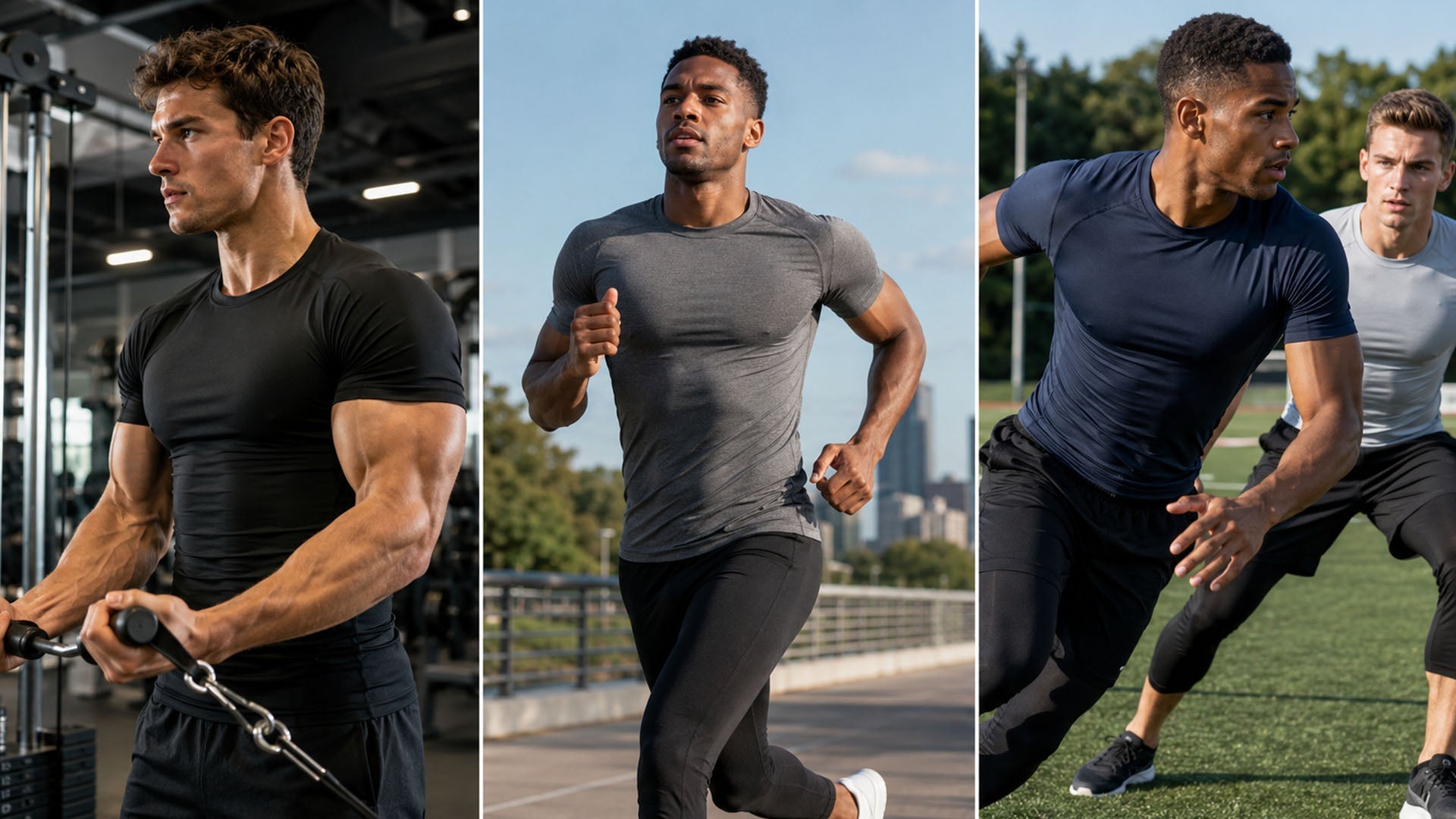
How to Choose the Right Compression Shirt for Gym, Running & Team Sports
A compression shirt should feel close, stable and supportive without making natural movement or deep breathing more difficult.
This guide focuses on activity-based selection rather than broader compression shirt performance claims.
To choose the right compression shirt, begin with the activity, wearing environment and layering conditions—not with the tightest available fit.
A shirt that feels comfortable while standing still may pull across the shoulders during an overhead press. It may rub under the arms after several miles of running or bunch beneath a team jersey once the athlete starts sprinting and turning.
That is why the same compression shirt will not suit every sports program equally well.
For gym training, shoulder mobility, stretch recovery and hem stability usually deserve priority. For running, quick drying and low-friction construction become more important. For team sports, the shirt must also work beneath uniforms or protective equipment.
Start With the Sport and Wearing Conditions
Before comparing fabrics, seams or extra features, decide how the shirt will actually be worn.
Is it intended for indoor strength training, outdoor running or team practice? Will athletes wear it alone, beneath a jersey or under protective equipment? Does the product need to suit a warm gym, cool-weather training or several seasons?
These conditions determine which details matter most.
| Main activity | First priority | Common problem to avoid |
|---|---|---|
| Gym and weightlifting | Shoulder mobility and hem stability | Restriction during pressing, pulling or squatting |
| Running | Quick drying and low-friction construction | Chafing and a heavy, sweat-soaked feel |
| Team sports | Layering compatibility and durability | Bunching beneath uniforms or protective equipment |
A general sports compression shirt can work across several activities. However, brands developing a product for one primary use should evaluate it around that activity’s repeated movements and wearing conditions.
A long feature list cannot compensate for a shirt that does not move well in its intended environment.
Check the Fit Before Comparing Features

A proper compression fit should stay close to the chest, shoulders and torso. It should not hang like a regular T-shirt, but it should not feel as though the wearer has simply chosen a size that is too small.
Begin with breathing. The wearer should be able to take a full breath without excessive pressure across the chest, ribs or neckline.
Then check movement. Raise both arms overhead, rotate the shoulders, reach across the body and bend forward. The shirt should follow the body without pulling sharply at the underarms or dragging the neckline backward.
The hem also needs attention. It may move slightly during exercise, but it should return naturally rather than gradually remaining above the waist.
A quick five-step movement test can reveal many fit problems:
-
Take a full, deep breath.
-
Raise both arms above the head.
-
Rotate the shoulders forward and backward.
-
Bend, twist and return to an upright position.
-
Recheck the neckline, underarms, sleeves and hem.
Some tension lines are normal in a close-fitting garment. Heavy horizontal lines across the chest or back, pinching around the armholes, numbness or restricted breathing are different. They usually indicate that the size or pattern balance is wrong.
Choosing one size smaller is not a reliable way to create stronger compression. The intended fit should come from the pattern, fabric and stretch recovery—not from forcing the wearer into a smaller garment.
Choosing a Compression Shirt for Gym and Weightlifting
A gym compression shirt must move through pressing, pulling, lifting, squatting and bending without constantly shifting out of position.
Shoulder mobility is the first detail to inspect.
Overhead presses, pull-ups, rows and bench presses place different demands on the shoulder and upper back. If this area is too restrictive, the shirt may pull across the back, dig into the underarm or lift excessively from the waist.
Four-way stretch is useful, but stretch alone does not tell the full story. The fabric also needs to recover after repeated movement.
Some materials feel highly elastic when stretched by hand but gradually relax around the elbows, chest or waist during training. A development sample should therefore be checked after a realistic workout, not only during the first fitting.
When reviewing a gym compression shirt sample, we do not judge hem stability while the wearer is standing still. We check it again after overhead reaches, squats and repeated pulling movements. A hem that rises briefly and returns is different from one that gradually stays above the waist.
Body length must also be balanced. Too little length increases ride-up, while excessive length can gather around the waist or bunch when the shirt is tucked in.
Seam construction is another consideration. Low-profile seams can reduce surface irritation, but their position matters just as much as their thickness. Even a smooth seam may become uncomfortable if it runs through a high-movement area or sits beneath repeated contact with a bench.
For a gym or workout compression shirt, the practical priorities are:
-
Free shoulder and upper-back movement
-
Reliable stretch recovery
-
Stable coverage during bending and lifting
-
Low-profile construction around the shoulders and underarms
-
Enough durability for repeated contact with gym equipment
Odor control may be helpful for frequent training, but it should remain a supporting feature. Brands should confirm whether the effect comes from the fiber itself or an applied finish, and whether it is expected to remain after washing.
The right gym compression shirt is not the one that feels tightest. It is the one that remains close and stable throughout the full exercise range.
Choosing a Compression Shirt for Running

Running creates thousands of repeated arm and torso movements. A small construction issue that feels harmless during a short fitting can become obvious several miles later.
Friction control should therefore be one of the first checks.
Look at the seams beneath the arms, along the side body and across the shoulders. These areas are repeatedly exposed to movement and sweat. Bulky seam intersections, rough labels or poorly finished armhole edges may become uncomfortable once the fabric is damp.
A dry fitting cannot reveal every running-related friction problem. During sample evaluation, the shirt should also be checked after it becomes damp because wet fabric may cling more closely to the skin, while labels and seam intersections can feel more noticeable.
Moisture management involves more than adding a “moisture-wicking” claim to the product description.
The fabric needs to move moisture away from the skin and release it efficiently. If it retains too much sweat or dries slowly, the shirt can become heavier, cling more tightly and increase surface friction.
A realistic running test should check:
-
Whether the shirt feels noticeably heavier when wet
-
Whether the underarms or side seams begin to rub
-
Whether the hem gradually moves upward
-
How the fabric looks and feels as it dries
-
Whether light colors become excessively transparent when damp
Sleeve coverage should follow the weather and expected exposure.
A lightweight short-sleeve compression shirt suits many general running programs. Sleeveless designs can provide more open arm movement, but the armhole edges must remain smooth and offer suitable coverage. Long sleeves may work better for cool conditions, sun coverage or layering beneath a running jacket, provided the fabric does not trap excessive heat.
Reflective details can also support low-light outdoor training. They are useful for certain running programs but are not essential for every sports compression shirt.
For running, prioritize quick drying, low-friction construction, stable fit and coverage suited to the weather.
Choosing a Compression Shirt for Team Sports
A compression shirt for team sports often has to function as part of a complete uniform rather than as a standalone top.
Start by checking how it layers beneath the jersey, training vest or protective equipment.
A bulky neckline may remain visible above the uniform. Sleeves may extend beyond the jersey, while excess fabric around the waist can gather when the outer layer is tucked in. The shirt should remain close enough to prevent bunching without restricting sprinting, reaching, throwing or rapid changes of direction.
Protective equipment creates additional pressure points. Where possible, thick seam intersections should not sit directly beneath pads, guards or other equipment that repeatedly presses against the body.
Team products also experience frequent washing and more physical contact than many individual training shirts. Fabric recovery, seam durability and fit retention are therefore more important than they may appear in a new sales sample.
A medium-size sample cannot confirm performance across an entire team order. Before approving the range, brands should check whether the neckline, sleeve opening, body length and overall compression feel remain balanced in smaller and larger sizes.
The product must also match the outer uniform. Sleeve length, neckline shape and color should be confirmed early so the base layer does not create avoidable problems with team appearance or playing requirements.
For team sports, the strongest option is usually a low-profile, durable compression shirt that layers cleanly and maintains a consistent fit across the intended size range.
Short Sleeve, Long Sleeve or Sleeveless?
Sleeve length should follow the activity, climate and layering plan rather than appearance alone.
| Style | Often suited to | Main point to check |
|---|---|---|
| Sleeveless | Warm indoor training and activities requiring open arm movement | Armhole coverage and edge friction |
| Short sleeve | Gym, running and general sports programs | Sleeve grip and underarm comfort |
| Long sleeve | Cool-weather training and base-layer programs | Heat management and cuff stability |
Sleeveless shirts are not automatically cooler if the fabric holds moisture. Long sleeves are not necessarily warm if the material is lightweight and breathable.
For a collection serving several sports, a short-sleeve style is often the most versatile starting point. Sleeveless and long-sleeve versions can then be developed for more specific climates, layering conditions or athlete preferences.
A Quick Checklist Before You Choose
A product description cannot show how a compression shirt will behave in motion. Before selecting a style or approving a development sample, put it through a realistic movement and wear test.
Check whether:
-
The wearer can take a deep breath without restriction.
-
The shoulders move freely through the required exercise range.
-
The shirt stays close without creating painful pressure.
-
The hem returns to position after bending or overhead movement.
-
Seams or labels rub the underarms, shoulders or side body.
-
The fabric recovers after repeated stretching.
-
The shirt becomes heavy, clingy or transparent when wet.
-
It layers smoothly beneath a jersey or protective equipment.
-
Its fit remains stable after washing.
Not every compression shirt needs every available feature. A simpler product with the right fit and construction is usually more useful than a feature-heavy design that does not suit its main activity.
Final Recommendation
Choose the compression shirt around the movement, environment and layering requirements of its main sport.
For gym and weightlifting programs, focus on shoulder mobility, stretch recovery and hem stability.
For running, prioritize quick drying, low-friction construction and weather-appropriate coverage.
For team sports, check uniform compatibility, durability and fit consistency across the size range.
One well-balanced core style may serve several sports programs. Activity-specific versions, however, should be adjusted around the movements, climate and layers athletes will experience in actual use.
If your brand is developing custom compression shirts for gym training, running or team sports, Diguan Apparel can help evaluate fabric, fit and construction options before sampling and bulk production.
Frequently Asked Questions
Should I size down when choosing a compression shirt?
Not by default. Begin with the supplier’s size chart and intended compression fit. Choosing a smaller size may restrict breathing or shoulder movement without improving the garment’s overall performance.
Is a tighter compression shirt better for gym workouts?
No. It should remain close and stable, but excessive tightness can interfere with deep breathing, shoulder mobility and comfort during longer training sessions.
Can one compression shirt work for gym, running and team sports?
Yes, if it provides balanced stretch, moisture control, low-friction construction and a stable fit. However, a specialized design may be more suitable when running conditions, protective equipment or uniform requirements create additional demands.
Related Articles

Cold Weather Running Hoodies: Thermal and Fleece Options for Brands
Develop cold weather running hoodies around the intended pace and layers. Learn how thermal, fleece and brushed options differ, then check damp comfort and sample fit before approval.
Read more
Lightweight Running Hoodies: How Brands Check Low-Bulk Performance
A lightweight running hoodie needs more than a low dry weight. Learn how brands compare hood and cuff bulk, added wet weight, drying behavior and comfort during running before approving a sample.
Read more
Running Hoodie vs Sweatshirt: Hooded Shirts, Crewnecks & Naming
A running hoodie may be a hooded sweatshirt or a lightweight jersey top. Learn how hoodie, sweatshirt, crewneck and hooded shirt names relate to garment structure, with clear naming examples for apparel brands.
Read more
Can You Run in a Hoodie? Training Use vs Post-Run Wear
Can you run in a hoodie? The answer depends on the conditions and how it feels once you warm up and sweat. This guide separates easy running, sustained training and post-run wear, helping brands define a hoodie’s main use before sampling.
Read more
Why Does a Compression Shirt Ride Up? Hem, Body Length & OEM Fixes
A compression shirt can sit smoothly at rest and still ride up on a run. Learn how brands can investigate hem rolling, loose openings and lost coverage, then compare targeted sample changes before bulk production.
Read more
Leave a comment
Your email address will not be published.